Evaluating the Educational Impact of Boys Presenting Cyborg at Robotics Class
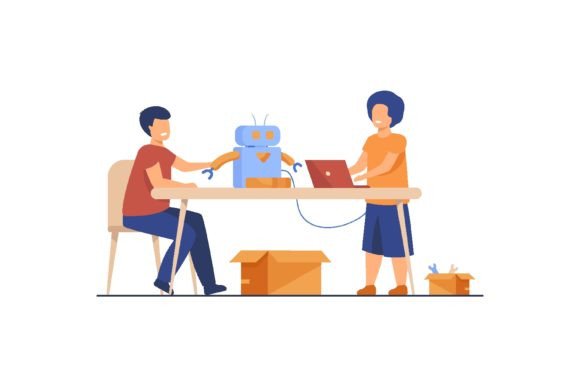
The scene of Boys Presenting Cyborg at Robotics Class has become a defining visual in modern STEM education. This specific imagery, often captured as a vector illustration or photograph, depicts students showcasing a robotic project to an educator. While it may appear to be a simple stock image representing school projects, the concept behind it offers a rich framework for understanding how robotics is integrated into curricula, how student learning is assessed, and what tools are most effective for teaching complex engineering concepts. For parents, educators, and curriculum developers aged 20 to 50, evaluating this scenario requires looking beyond the surface level of "kids building robots" to understand the pedagogical strategies, resource requirements, and developmental outcomes involved.
When we analyze Boys Presenting Cyborg at Robotics Class, we are essentially examining a snapshot of project-based learning (PBL). The distinct nature of this educational moment lies in the transition from theoretical knowledge to practical application. Unlike traditional lecture-based instruction, where students passively absorb information about mechanics or coding, this scenario highlights the active demonstration of competence. The "cyborg" element—often a robot with human-like features or functions—adds a layer of complexity that bridges biology, engineering, and computer science. It forces students to consider not just how a machine moves, but how it interacts with its environment and mimics organic systems.
Distinguishing Features of Project-Based Robotics Learning
What makes the concept of Boys Presenting Cyborg at Robotics Class distinct from other forms of technical education is the emphasis on communication and synthesis. In many introductory coding classes, the focus remains strictly on the syntax of the language or the logic of the algorithm. However, when students are tasked with presenting a physical prototype, such as a cyborg, they must synthesize their technical work into a coherent narrative. They must explain their design choices, troubleshoot visible issues, and articulate the function of their creation to a critical audience, represented by the teacher.
This approach differs significantly from standardized testing or isolated lab exercises. In a standard lab, a student might successfully wire a circuit but never have to justify why they chose a specific resistor value. In the context of presenting a cyborg, the justification becomes part of the learning process. The visual representation of this interaction—a child holding a device while a teacher observes—symbolizes the mentorship dynamic essential to advanced technical training. It suggests a feedback loop where the educator acts as a guide rather than just a grader, helping the student refine their understanding through critique and encouragement.
Comparing Robotics Formats: Kits vs. Open-Source Projects
To fully appreciate the utility of scenarios like Boys Presenting Cyborg at Robotics Class, one must compare the underlying resources used to create such projects. There are generally two primary approaches in school robotics: structured kit-based learning and open-source, build-from-scratch engineering.
- Structured Kits: These come with pre-designed parts and step-by-step instructions. They are excellent for beginners, ensuring a high success rate and reducing frustration. However, they can limit creativity. A student following a kit might build a functional robot but lack the deep understanding required to modify it into a unique "cyborg" design.
- Open-Source Projects: These require students to source materials, write custom code, and design mechanical components. This aligns more closely with the complexity implied in a presentation scenario. The tradeoff is a steeper learning curve and a higher risk of failure during the construction phase.
The image of students presenting a sophisticated cyborg usually implies the latter category. If the goal is merely to introduce the concept of automation, a kit might suffice. However, if the objective is to prepare students for future careers in engineering or computer science, the open-source approach offers superior depth. Educators must weigh the time investment against the depth of learning. A classroom using kits may cover more topics quickly, but a classroom focusing on open-ended projects like the cyborg presentation will likely produce students with stronger problem-solving skills and resilience.
Assessing the Role of Visual Tools and Illustrations
It is also worth considering how visual representations, such as vector illustrations of Children showing robot to teacher, influence our perception of these programs. These images are frequently used in marketing materials for schools, after-school programs, and educational technology companies. They serve as a shorthand for "success" and "engagement."
While these visuals are compelling, they can sometimes oversimplify the reality of the classroom experience. A polished vector illustration cannot convey the hours of debugging, the broken wires, or the moments of confusion that precede a successful presentation. When evaluating educational resources, adults should look past the idealized imagery to assess the actual curriculum. Does the program provide sufficient support for the inevitable failures? Is there a structured method for peer review before the final presentation to the teacher? The presence of a "presentation day" is valuable, but the scaffolding leading up to it determines the true educational value.
Strengths, Tradeoffs, and Decision Factors
Deciding whether to adopt a curriculum centered around complex presentations like Boys Presenting Cyborg at Robotics Class involves weighing several factors. One of the primary strengths is the development of soft skills alongside technical ones. Public speaking, teamwork, and critical thinking are honed when a student stands before a teacher to defend their design. This holistic development is often missing in purely digital coding courses.
However, there are significant tradeoffs. Resources for open-ended robotics projects can be expensive. High-quality sensors, microcontrollers, and durable chassis components cost more than basic electronics kits. Furthermore, the teacher's expertise becomes a critical variable. An instructor who is comfortable troubleshooting hardware and software in real-time is essential. Without adequate teacher training, a project-based class can devolve into chaos, leaving students frustrated and disengaged.
Another decision factor is the age and skill level of the students. For younger children, the complexity of building a "cyborg" may be overwhelming without heavy scaffolding. In these cases, simplified versions of the activity, perhaps focusing on a single function like a robotic arm or a moving head, might be more appropriate. As students mature, the scope can expand to include artificial intelligence, sensor fusion, and advanced mechanics. The flexibility of the curriculum to scale with student ability is a key indicator of its long-term viability.
When This Approach Is the Right Choice
The model exemplified by Boys Presenting Cyborg at Robotics Class is particularly well-suited for environments aiming to foster innovation and leadership. It is the right choice for schools or programs that want to move beyond rote memorization and encourage students to think like engineers. It is also ideal for extracurricular clubs where students have a genuine interest in robotics and are willing to invest extra time in mastering complex systems.
Furthermore, this approach is beneficial for students who learn best through kinesthetic and visual methods. Seeing the physical result of their code and design work reinforces abstract concepts. The social aspect of presenting to a teacher and peers also helps introverted students find confidence in their technical abilities, provided the environment is supportive and non-judgmental.
Conversely, this approach may not be the best fit for every situation. If the primary goal is rapid certification in a specific programming language, a more direct, lecture-and-lab format might be more efficient. Similarly, in under-resourced settings where funding for hardware is limited, focusing on simulation software or low-cost electronics might be a more pragmatic alternative. In these contexts, the "cyborg" project could be adapted to use recycled materials or virtual simulations, maintaining the spirit of the activity without the prohibitive costs.
Conclusion: Making an Informed Educational Choice
Ultimately, the concept of Boys Presenting Cyborg at Robotics Class represents more than just a catchy headline or a stock photo; it symbolizes a shift toward experiential, student-centered learning in STEM fields. Whether you are a parent choosing an after-school program, an administrator selecting a curriculum, or an educator designing a lesson plan, the decision hinges on your specific goals and constraints.
By comparing the depth of open-ended projects against the accessibility of structured kits, and by considering the necessary resources and teacher expertise, you can determine if this high-engagement model fits your needs. The most effective educational strategies often blend different approaches, using the excitement of a final presentation to drive motivation while providing the structured support needed to ensure every student succeeds. As robotic technology continues to evolve, the ability to present, explain, and iterate on complex designs will remain a crucial skill, making these classroom moments increasingly relevant for the next generation of innovators.