Education Hand Drawn School Elements
In a digital landscape often dominated by sleek, vector-perfect icons and rigid corporate templates, there is a refreshing return to the imperfect. The Education Hand Drawn School Elements collection captures this shift perfectly. It offers a curated set of illustrations that feel as though they were sketched moments ago on a teacher's desk or a student's notebook. This isn't just about aesthetics; it is about injecting instant charm and creativity into educational projects. For educators, designers, and content creators, these hand-drawn assets serve as a bridge between the structured world of curriculum and the organic nature of learning.
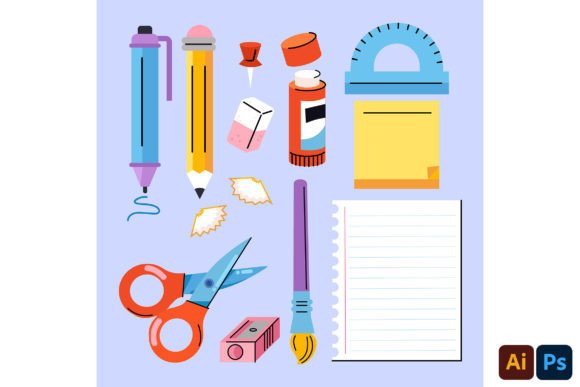
The collection includes essential tools like a pen, pencil, glue stick, scissors, eraser, sharpener, ruler, tack, notepad, paper, sticky note, and paintbrush. Each item retains the texture and slight irregularity of human creation. When you integrate these elements into your work, you are signaling to your audience that the content is approachable, human-centric, and designed with care. This subtle psychological cue can transform a dry lesson plan or a sterile marketing graphic into something inviting and memorable.
Why Hand-Drawn Aesthetics Matter in Education
The value of hand-drawn school elements extends beyond simple decoration. In the context of education, visual language plays a critical role in engagement. Students and adult learners alike respond positively to visuals that mimic the tools they use daily. A crisp, computer-generated icon of a pencil looks like a product; a hand-drawn sketch of a pencil looks like a tool ready for use. This distinction fosters a sense of familiarity and reduces the cognitive load required to process information.
For educators creating slide decks, worksheets, or classroom posters, these illustrations provide a cohesive visual theme without requiring advanced artistic skills. They allow you to maintain professional standards while adding a layer of warmth that standard clip art often lacks. Furthermore, the "hand-made" quality aligns well with modern pedagogical approaches that emphasize creativity, brainstorming, and the iterative nature of learning. It visually reinforces the idea that mistakes are part of the process, much like the presence of an eraser or a slightly crooked line in the drawing itself.
Practical Applications for Creators and Educators
The versatility of the Education Hand Drawn School Elements makes them suitable for a wide range of projects. Whether you are a freelance designer working on a brand identity for a tutoring center or a blogger writing about study tips, these assets can be adapted to fit various needs.
- Instructional Materials: Use the scissors, ruler, and glue stick to illustrate step-by-step guides for arts and crafts or science experiments. The visual cues help break down complex instructions into digestible steps.
- Digital Content: Incorporate the sticky note and notepad into blog headers, social media graphics, or email newsletters. These elements work exceptionally well to highlight key takeaways or "quick tips" within a text-heavy layout.
- Presentation Design: Replace generic bullet points with the pen, pencil, or paintbrush icons. This adds visual rhythm to your slides and keeps the audience focused on the content rather than the format.
- Marketing Collateral: Small business owners running educational workshops or publishing houses can use these illustrations to create brochures and flyers that feel personal and community-focused.
Consider a scenario where you are designing a course syllabus. Instead of a plain list of topics, you might place a small sketch of a book or a notepad next to each module title. This small touch transforms a bureaucratic document into a roadmap for discovery. Similarly, a marketer promoting an online course could use the paintbrush and pencil to symbolize the creative potential students will unlock, making the value proposition more tangible.
Technical Flexibility and Workflow Integration
One of the most significant advantages of this collection is its technical robustness. The source files are provided in Adobe Illustrator AI and EPS formats, ensuring full compatibility with CS6 and later versions. This is crucial for professionals who need to manipulate the artwork to fit specific design requirements. Unlike raster images that lose quality when resized, these vector files remain crisp at any scale, from a tiny favicon to a large banner ad.
Because the files are editable, you have complete control over the final look. You can change the stroke weight to match your brand guidelines, adjust the color palette to align with your institution's colors, or isolate specific parts of an illustration for unique compositions. For instance, if your project requires a monochromatic scheme, you can easily recolor the entire set of school supplies to match. This flexibility ensures that the illustrations enhance your existing design system rather than clashing with it.
When working with these files, it is important to maintain consistency. While the hand-drawn style allows for some variation, keeping the stroke thickness and color saturation uniform across all elements creates a polished, professional result. Organize your layers logically within the Illustrator file to make future edits easier. Naming your layers clearly—such as "Pencil_Body," "Eraser_Cap," or "Ruler_Marks"—will save time if you need to revisit the project months later.
Creative Strategies for Maximum Impact
To truly leverage the power of these school elements, consider how they interact with typography and layout. Hand-drawn illustrations pair beautifully with handwritten-style fonts or clean, sans-serif typefaces that offer high readability. Avoid pairing them with overly ornate serif fonts, as this can create visual clutter. The goal is to let the illustrations breathe and support the message, not compete with it.
You can also use these elements to guide the viewer's eye through a composition. A diagonal placement of a ruler or a scattered arrangement of sticky notes can introduce dynamic movement to a static page. This technique is particularly effective in infographics where data needs to be presented in an engaging way. By anchoring statistics with relevant icons—like using a pencil to denote "writing assignments" or a glue stick for "collaboration"—you create mental associations that aid retention.
For those looking to expand their creative horizons, try combining these school elements with other textures. Adding a subtle paper grain background or a watercolor wash behind the vector illustrations can deepen the tactile feel of the design. This layering technique works well for print materials like workbooks or certificates, giving them a premium, artisanal quality that stands out in a sea of digital downloads.
Adapting for Different Audiences
The appeal of hand-drawn school elements transcends age groups. While they naturally resonate with children and K-12 educators, they are equally effective for adult learning environments. For professional development workshops, corporate training, or university lectures, these illustrations soften the tone of serious subjects. They suggest a collaborative, open-minded atmosphere where ideas can be freely exchanged.
Marketers targeting parents can use these assets to evoke nostalgia and trust. Images of classic school supplies trigger positive memories of childhood learning, making educational products feel safe and reliable. Conversely, entrepreneurs launching ed-tech startups can use these elements to humanize their software interfaces, showing users that there is a real team of people behind the technology.
Ultimately, the Education Hand Drawn School Elements collection is more than a set of graphics; it is a toolkit for storytelling. It empowers creators to communicate complex ideas with simplicity and warmth. By integrating these delightful illustrations into your workflow, you foster inspiration for both yourself and your audience. Whether you are designing a classroom poster, a website header, or a marketing campaign, these elements provide the perfect balance of structure and creativity, ensuring your message is not just seen, but felt.